
iPhone Cage Comparison: SmallRig vs Freewell vs Beastgrip
Which iPhone cage for filmmaking is best? Comparing three of my favourites.
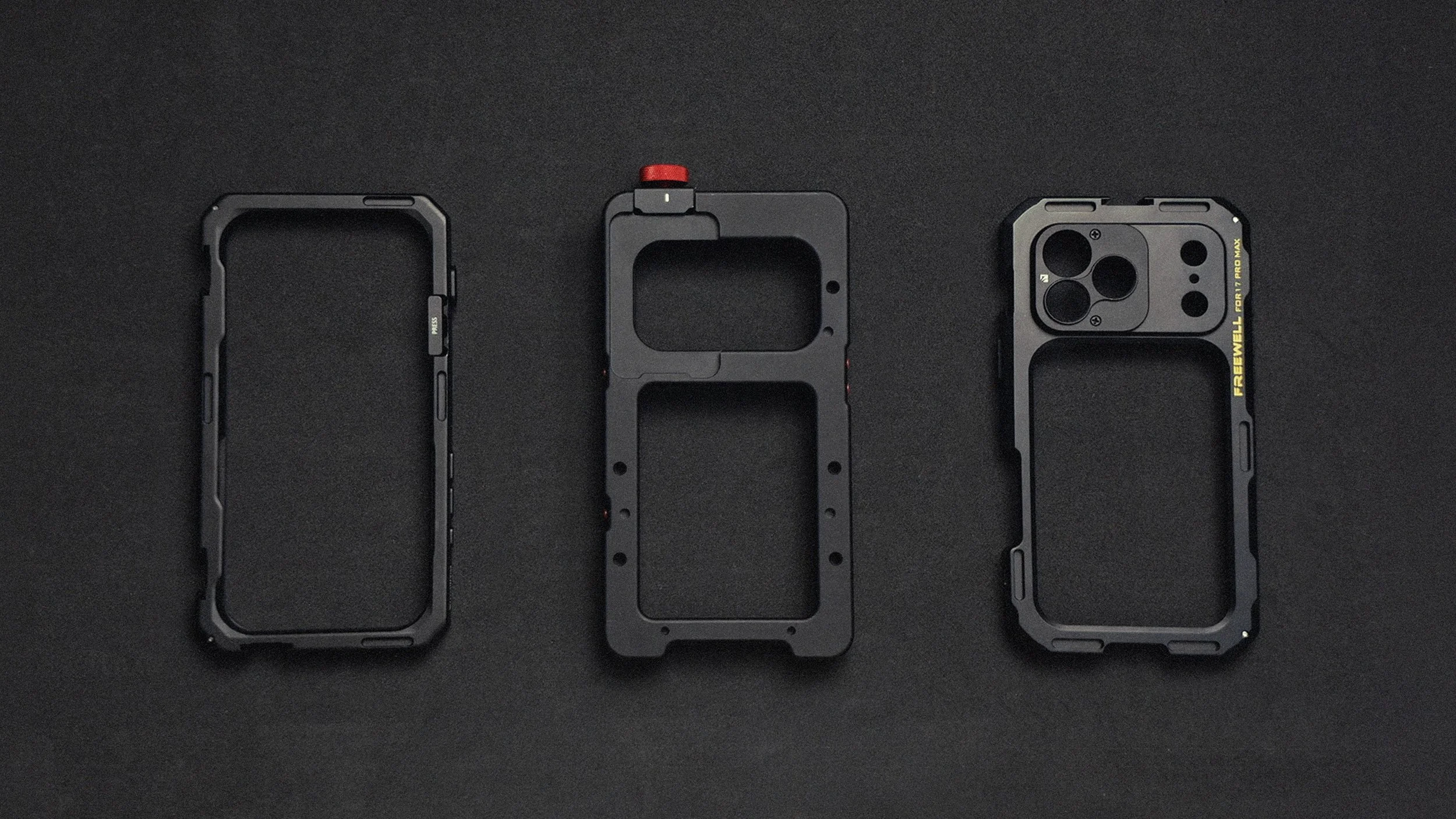
Small Rig (Left), Beastgrip (Middle), Freewell (Right) — Cages for iPhone 17 Pro Max.
The iPhone has become a seriously capable filmmaking tool, but once you start adding lenses, filters, microphones, lights, handles, SSDs and other accessories, a cage quickly becomes one of the most important parts of the setup. For this review, I’m comparing three of the main mobile filmmaking cage options I’ve been testing: the SmallRig Kit, the Freewell Genius Cage Rig, and Beastgrip.
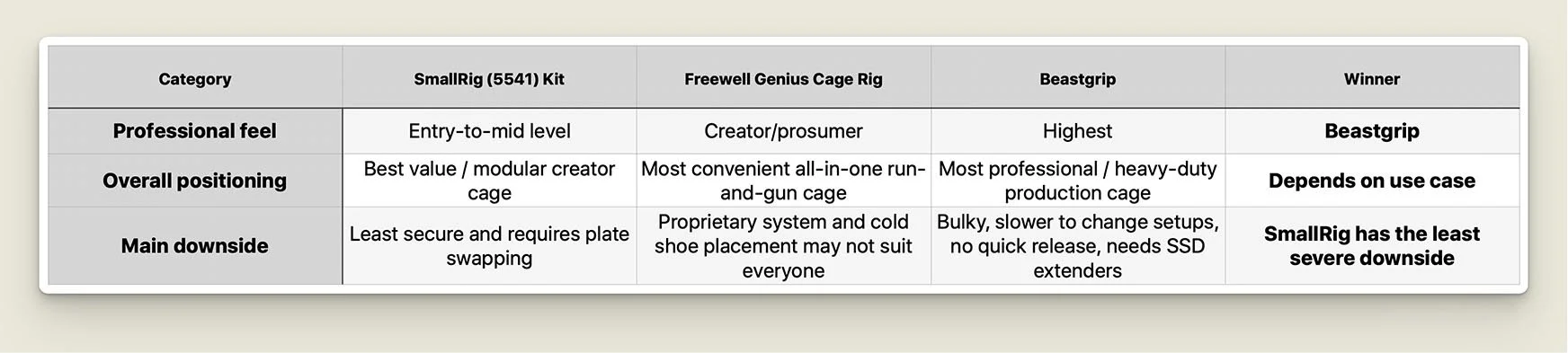
I genuinely like all three of these cages, but they each approach mobile filmmaking from a very different angle. SmallRig is the affordable and modular option, Freewell is the quick and convenient all-rounder, and Beastgrip is the most robust and production-focused system. None of them are perfect, and each has its own strengths, compromises and ideal use cases. By the end of this review, I’ll give my recommendations on which cage I think is best depending on the type of filmmaker / videographer you are and the kind of setup you’re building.
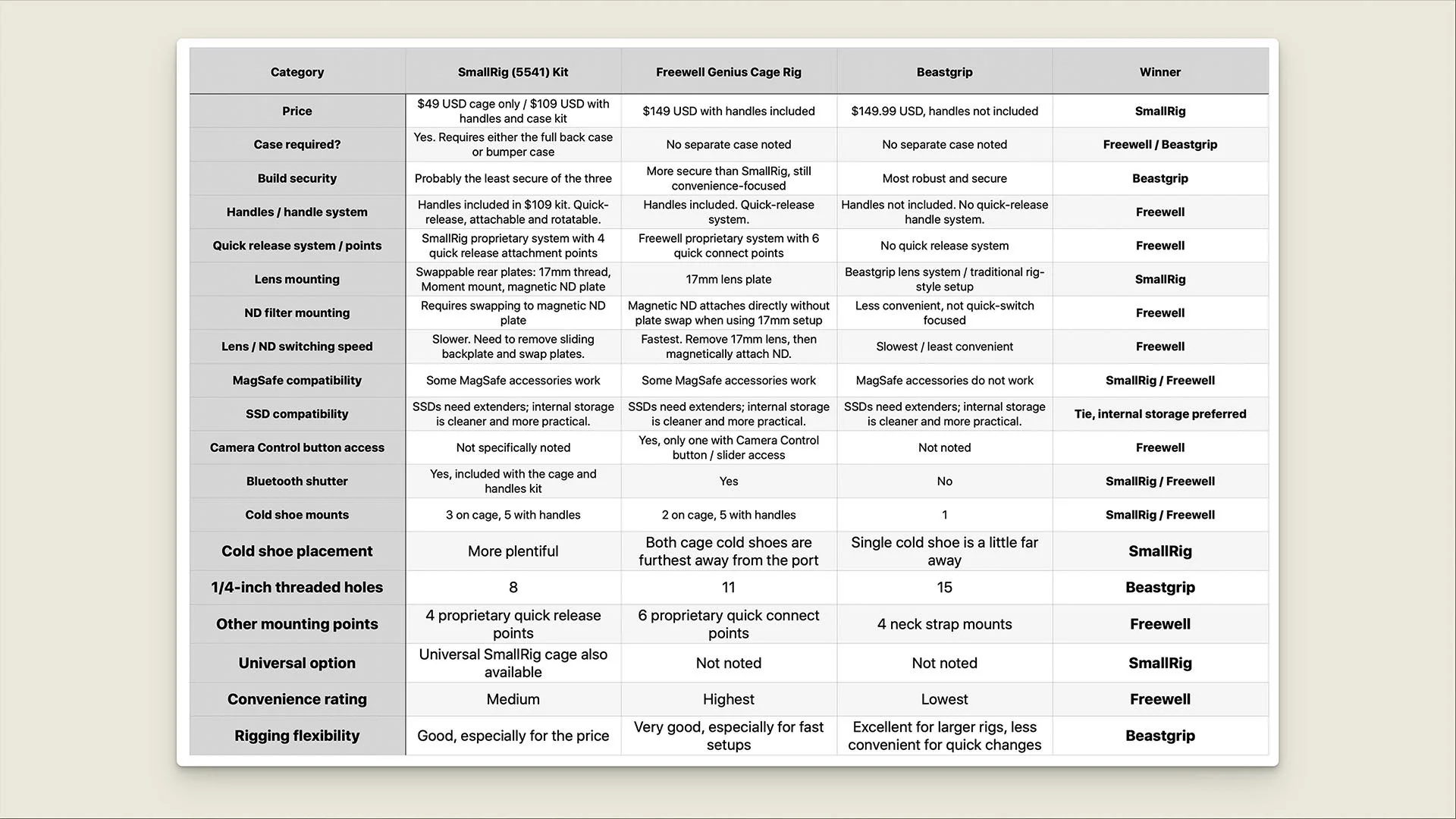
If you want to quickly compare these cages, there’s also a comparison matrix table, pictured below.
A Quick Disclaimer
All three brands sent these products for me to use and try out. Although many of the accessories and other products scattered throughout the video plus this written review, I have purchased.
SmallRig Cage
The SmallRig Kit is the most affordable option of the three, with the cage alone coming in at $49 USD, or $109 USD for the cage, handles and case kit. That makes it a really appealing entry point for anyone wanting to build out an iPhone 17 Pro filmmaking setup without spending too much straight away. It still gives you a decent amount of mounting flexibility, with three cold shoe mounts on the cage, five with the handles attached, eight 1/4-inch threaded holes, and four SmallRig proprietary quick release attachment points.
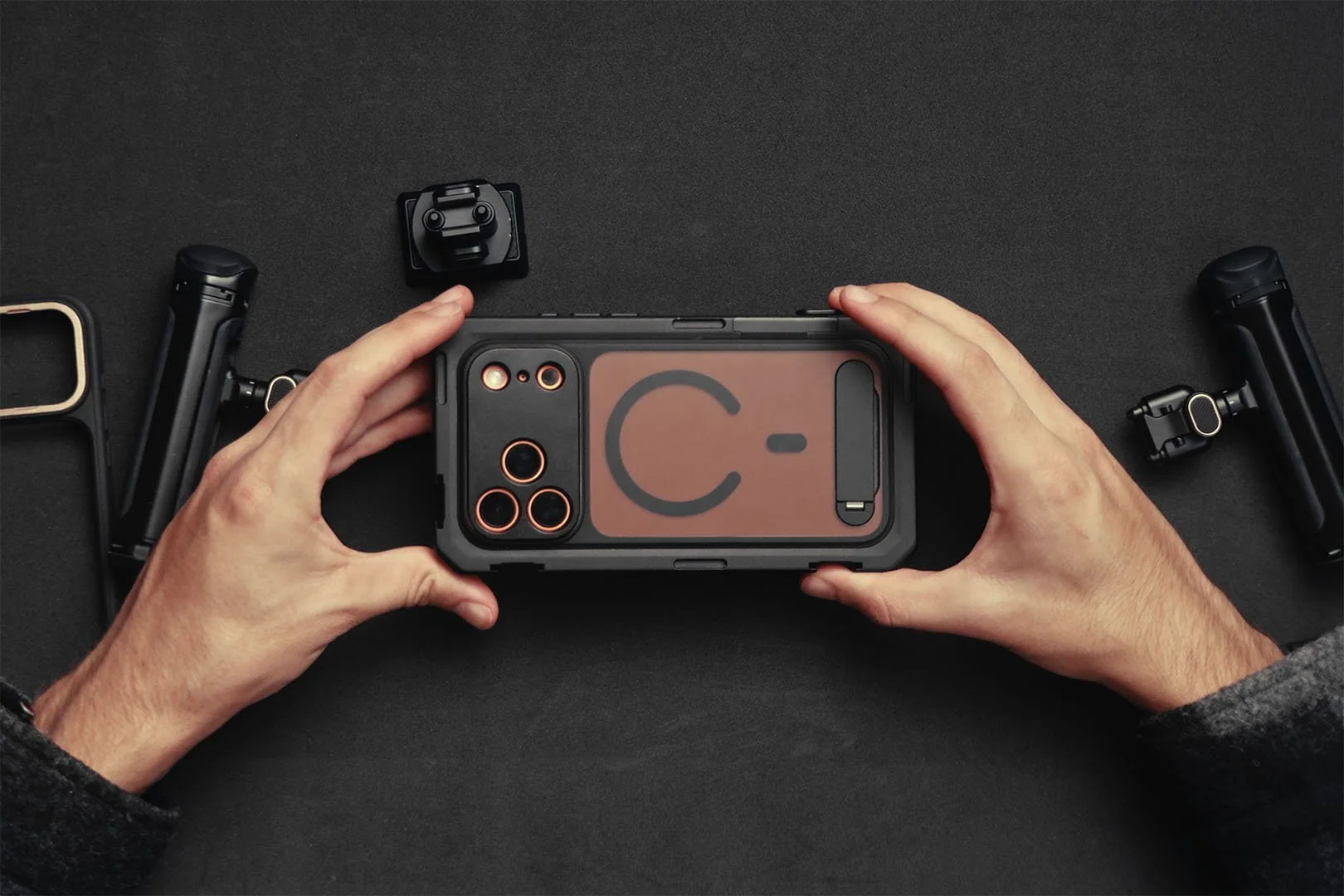
SmallRig cage mounted on the iPhone 17 Pro, showing the rear plate system, MagSafe area, and quick-release handle attachments.
Where SmallRig gets interesting is in its modularity. You can swap between different rear plates depending on whether you want to use magnetic ND filters, 17mm threaded lenses, or Moment mount lenses. The handles are also quick-release, attachable and rotatable, which makes the system feel quite flexible for the price. The trade-off is that changing between lens and filter setups is slower than something like the Freewell, because you need to remove the sliding backplate and swap plates. It also feels like the least secure and least refined system of the three, but considering the price, it still offers a lot.
Advantages
Most affordable option, especially considering the $109 kit includes handles.
Good modularity with magnetic ND, 17mm thread and Moment lens plates.
Solid mounting options for the price, including five cold shoes with handles.
Disadvantages
Lens and ND changes are slower because of the plate-swapping system.
Requires a case, either the full back or bumper case.
Feels like the least secure and least refined of the three.
Freewell Cage
The Freewell Genius Cage Rig feels like the most convenient option out of the three. At $149 USD with handles included, it sits in a more premium price bracket than SmallRig, but it also feels like the most complete run-and-gun kit straight out of the box. It includes quick-release handles, six Freewell proprietary quick connect points, eleven 1/4-inch threaded holes, two cold shoe mounts on the cage, and five cold shoe options when the handles are attached.
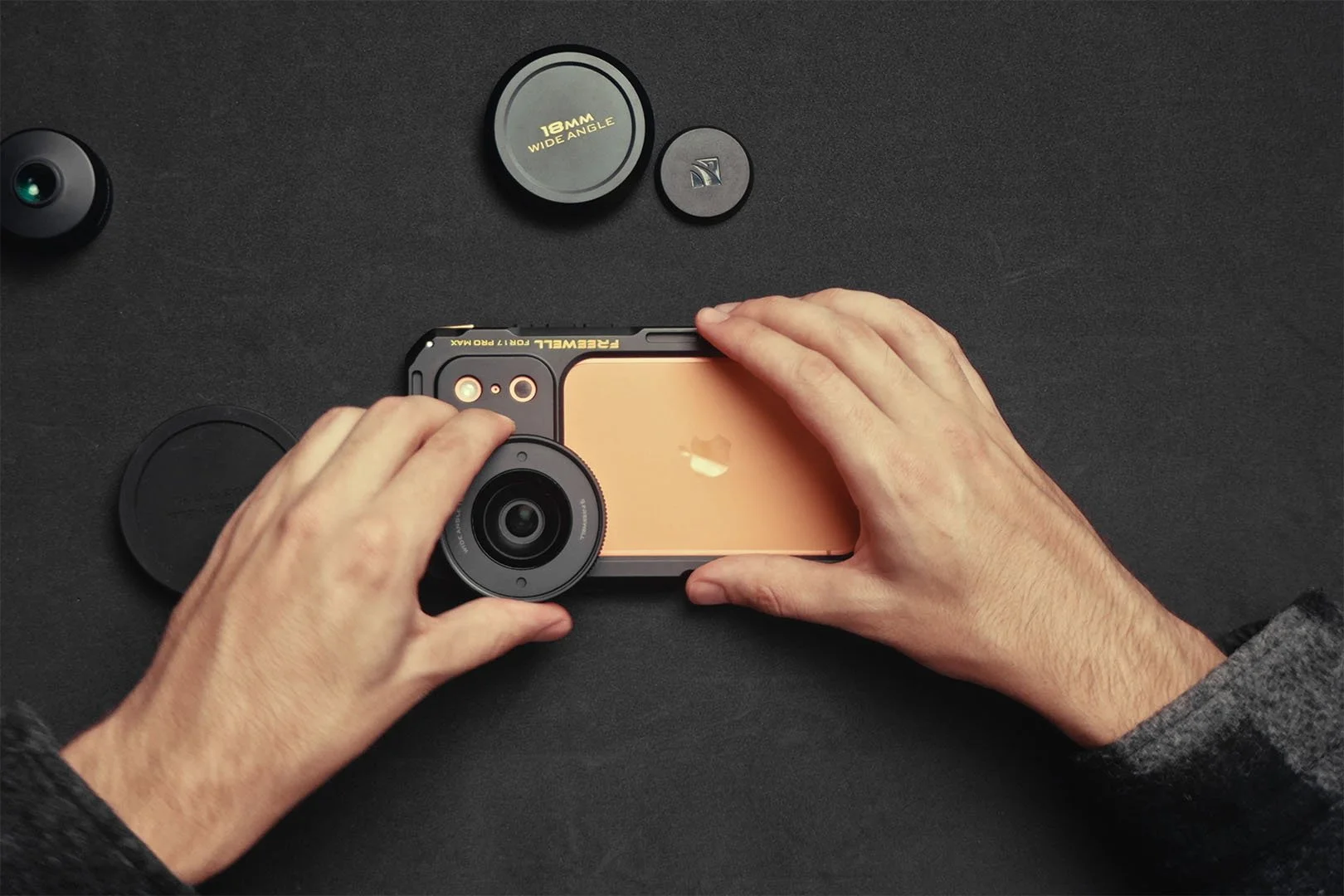
Freewell Genius Cage Rig mounted on the iPhone 17 Pro, shown with its 17mm lens setup and magnetic filter system nearby.
The biggest strength of the Freewell cage is how quickly you can change setups. If you’re using a 17mm lens, you can simply remove the lens and magnetically attach the Freewell ND filter without having to change plates. That makes it the fastest and most practical system here for switching between lenses and filters while shooting. It’s also the only one of the three with access to the iPhone Camera Control button / slider, and it includes a Bluetooth shutter. The main downside is that it still uses a proprietary system, and the cold shoe placement may not suit everyone, especially since the two cage-mounted cold shoes are positioned furthest away from the port.
Advantages
Fastest and most convenient cage for changing between lenses and ND filters.
Handles, Bluetooth shutter and quick-release system are included.
Only cage here with access to the iPhone Camera Control button / slider.
Disadvantages
More expensive than SmallRig.
Cold shoe placement may not suit every setup.
Proprietary Freewell quick connect system may limit accessory flexibility.
Beastgrip Cage
Beastgrip is the most professional and production-focused cage of the three. It feels like the most robust system, with fifteen 1/4-inch threaded mounting points, four neck strap mounts, and a more traditional rigging approach. It has also been used in serious production environments, from Apple keynote-style setups through to larger film and commercial workflows, and it’s the cage I used on my most recent shot-on-iPhone short film, Singer.
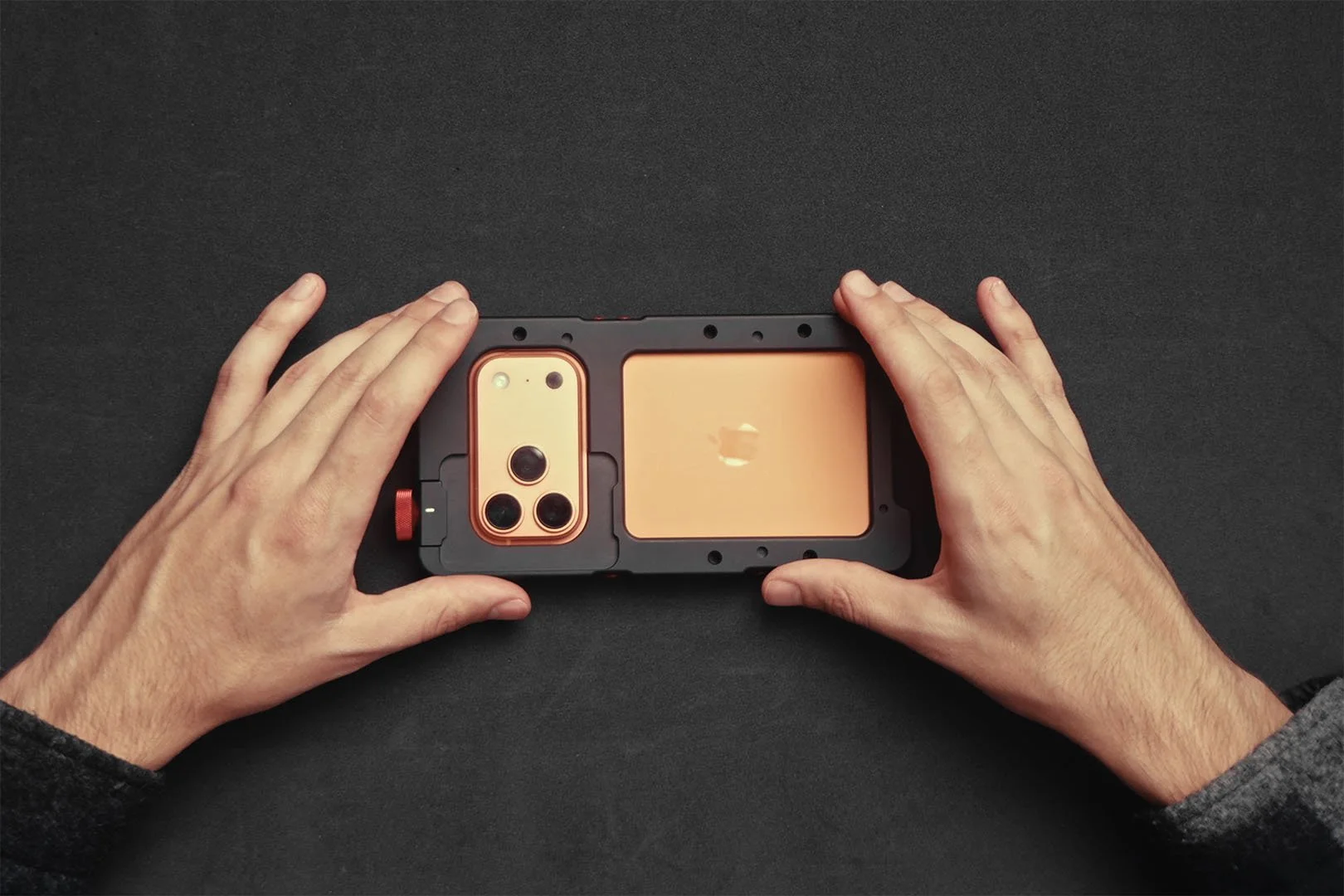
Beastgrip cage mounted on the iPhone 17 Pro, showing its larger, more robust frame design and production-focused mounting layout.
The downside is that Beastgrip is by far the least convenient option for fast setup changes. It doesn’t have a quick release system, the handles are not included, MagSafe accessories do not work, and it only has one cold shoe mount, which is also a little further away than I’d personally like. It’s the cage I’d trust most for bigger builds, commercial shoots and more controlled production environments, but it’s not the one I’d reach for if I wanted the fastest, lightest or most flexible day-to-day setup.
Advantages
Most robust and professional-feeling cage of the three.
Best suited to bigger builds, commercial shoots and serious rigging.
Most 1/4-inch threaded mounting points, with fifteen in total.
Disadvantages
Least convenient for quick setup changes.
Handles are not included and there is no quick release system.
MagSafe accessories do not work, and there is only one cold shoe mount.
Verdict
After comparing all three cages, the right choice really depends on the kind of mobile filmmaking setup you’re building. SmallRig is the most affordable and flexible entry point, Freewell is the fastest and most convenient cage for day-to-day shooting, and Beastgrip is the most robust option for serious production builds. None of them are perfect, but each one clearly serves a different type of filmmaker.
My Recommendations
SmallRig
SmallRig is the best option for anyone who wants an affordable cage with solid mounting options and good modularity. It gives you a lot for the price, especially with the handle kit, but it does feel like the least refined system of the three. If you’re happy to work around a few compromises, it’s probably the best value pick.
Pricing: $50 - $109 USD
Freewell
Freewell is the one I’d recommend for most mobile filmmakers. It’s the quickest to use, the easiest to adapt on the fly, and the most convenient when switching between lenses, ND filters, handles and accessories. If you want something practical for run-and-gun iPhone filmmaking, this is the strongest all-rounder.
Price: $149.00 USD
Beastgrip
Beastgrip is the best choice for bigger builds, commercial shoots and more serious rigging. It feels the most robust and production-ready, but that comes at the cost of speed and convenience. If you care more about stability, strength and a professional rigging platform than quick setup changes, Beastgrip makes the most sense.
Price: $149.00 USD
Apple Log LUTs and Powergrades
Support our short filmmaking and these reviews, plus level up your iPhone cinematography looks with my digital products here.
YouTube Video Review
Coming Soon. My video review and comparison of these three cages.
